
Measure an ozone concentration
Monitoring and measuring the concentration of ozone in water is essential for applications like water treatment, disinfection, and industrial processes. There are several methods to determine ozone concentration in water, each with varying levels of accuracy and complexity.
Colorimetric (Indigo Method)
- The most widely used method.
- Uses an indigo trisulfonate reagent, which reacts with ozone and undergoes a color change.
- The decrease in absorbance at 600 nm is measured using a spectrophotometer.
- Pros: Simple, reliable, and widely accepted.
- Cons: Requires chemical reagents and lab analysis.
Electrochemical Sensors (Ozone Probes)
- Uses an amperometric or potentiometric sensor to detect dissolved ozone.
- The sensor measures the electrical current generated by ozone reduction at the electrode.
- Pros: Provides real-time, continuous monitoring.
- Cons: Requires calibration and regular maintenance.
UV Absorption Spectroscopy
- Ozone absorbs ultraviolet light at 254 nm.
- Measures the intensity of absorbed UV light to determine ozone concentration.
- Pros: Highly accurate and does not require chemical reagents.
- Cons: Expensive and requires clean water samples for precise measurements.
Gas Stripping with Gas-Phase Ozone Detection
- Ozone is stripped from the water into a gas phase and then measured using a gas-phase ozone analyzer (e.g., UV photometric or electrochemical sensors).
- Pros: Very precise, useful for low concentrations.
- Cons: Requires additional equipment and is complex to set up.
Oxidation-Reduction Potential (ORP) Monitoring
- Measures the oxidation potential of water, which correlates with ozone levels.
- Pros: Simple and inexpensive.
- Cons: Not specific to ozone, as ORP is affected by other oxidants (e.g., chlorine).
Our sustainable and professional offer
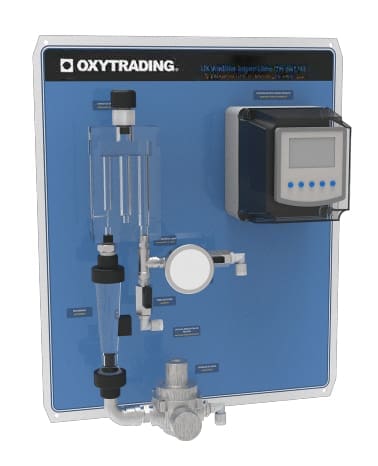
Our Dissolved Ozone Meter offered by Oxytrading is designed for precise measurement of ozone concentrations in water, catering to various applications such as water treatment, disinfection, and industrial processes.
For comprehensive specifications, operational features, and suitability for your specific needs, it’s recommended to contact Oxytrading directly or visit their official website. This will provide you with detailed insights into the product’s capabilities, installation requirements, and maintenance guidelines, ensuring it aligns with your application requirements.
Our dissolved ozone meter for water treatment
The Dissolved Ozone Meter we offer is a high-precision monitoring and control device designed for water treatment applications. It accurately measures ozone concentration in water, ensuring effective disinfection and oxidation processes. This advanced system provides real-time data, making it an essential tool for industries such as drinking water purification, wastewater treatment, food processing, and pharmaceutical production.
Key features & specifications
- Measurement range: 0-20 mg/L (ppm) – Allows for precise monitoring of ozone concentrations in various water treatment applications.
- Resolution: 0.01 mg/L – Ensures high accuracy in detecting even small changes in ozone levels.
- Output signal: 4-20 mA – Compatible with standard industrial control systems for seamless integration.
- Power supply: 230V, 50-60 Hz – Designed for stable operation in industrial environments.
- Dimensions: 560 × 460 × 180 mm – Compact and space-efficient for easy installation.
Operating conditions:
- Ambient Humidity: < 90% – Suitable for humid environments while maintaining reliable performance.
- Ambient Temperature: 0-60 ºC – Designed for operation in a wide range of environmental conditions.
- Fluid Temperature: 0-60 ºC – Compatible with various water treatment applications without performance degradation.
Our Dissolved Ozone Meter is an ideal solution for ensuring optimal ozone levels in water treatment processes, improving efficiency, safety, and compliance with regulatory standards.