Destruct units, leak detection, and ventilation requirements
Ozone is a highly effective oxidant for disinfection, oxidation, and odor control, but it is also a toxic gas at relatively low concentrations. For this reason, the design of any ozone generation system must place operator safety on equal footing with process performance. Regulatory agencies worldwide impose strict exposure limits, and failure to control ozone leakage can lead to health risks, regulatory violations, and equipment damage.
Safety objectives and regulatory context
Before addressing specific components, it is essential to define the safety targets that drive system design.
Typical occupational exposure limits include:
- OSHA (USA): 0.1 ppm as an 8-hour time-weighted average
- NIOSH: 0.1 ppm TWA, 0.3 ppm short-term exposure limit
- WHO / EU guidance: 0.05–0.1 ppm for continuous exposure
From a design perspective, the goal is not merely to remain below these limits, but to ensure that:
- Ozone is fully contained within process equipment
- Any off-gas is reliably destroyed or diluted
- Any abnormal release is detected rapidly and triggers automatic mitigation
The three controls discussed below work together as a layered safety system.
Destruct units: eliminating residual ozone
Purpose and function
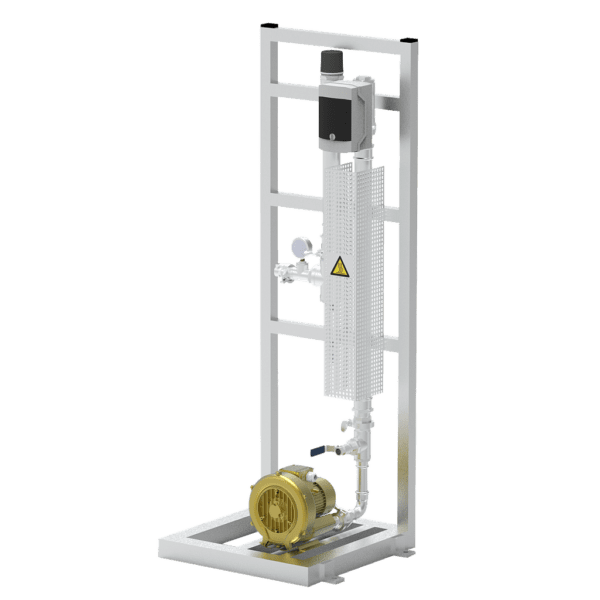
Destruct units (also called ozone destructors) are installed to remove residual ozone from off-gas streams before they are vented to occupied spaces or the atmosphere. Their purpose is to convert ozone (O₃) back into oxygen (O₂), eliminating exposure risk and preventing environmental release.
Destruct units are typically installed on:
- Contact tank off-gas outlets
- Ozone generator purge lines
- Vacuum exhaust lines in injection systems
Destruction technologies
The two most common destruction methods are:
- Thermal Destruct Units
- Use elevated temperature (typically 300–400°C)
- Very high destruction efficiency (>99.9%)
- Higher energy consumption
- Preferred for high-concentration industrial systems
- Catalytic Destruct Units
- Use manganese dioxide or similar catalysts
- Operate at ambient or moderately elevated temperatures
- Lower power consumption
- Require clean, dry gas to prevent catalyst fouling
Design considerations
When specifying a destruct unit, engineers should consider:
- Maximum ozone mass flow (g/h)
- Gas flow rate and pressure drop
- Inlet ozone concentration
- Redundancy for critical applications
- Monitoring of destruct outlet concentration
Best practice is to design for fail-safe operation, where loss of power or airflow automatically stops ozone generation.
3. Leak detection: early warning and automatic response
Rationale for continuous monitoring
Ozone has a sharp odor detectable by humans at very low concentrations, but relying on human perception is not acceptable in industrial safety design. Continuous leak detection provides:
- Early warning of seal failures or tubing leaks
- Protection during maintenance and start-up
- Documentation for regulatory compliance
Leak detection systems should be considered mandatory for:
- Enclosed ozone generator rooms
- High-capacity systems (>50–100 g/h)
- Installations in occupied buildings
Sensor placement strategy
Effective leak detection depends on proper sensor placement:
- Near ozone generators and power supplies
- At injection skids and contactor enclosures
- At breathing zone height (1.5–1.8 m above floor)
- Near exhaust outlets and doorways
Multiple sensors are recommended for larger rooms to avoid blind spots.
Alarm and interlock functions
A properly designed leak detection system should provide:
- Audible and visual alarms at low-level thresholds (e.g., 0.05 ppm)
- Automatic system shutdown at higher thresholds (e.g., 0.1–0.2 ppm)
- Integration with ventilation controls to increase air exchange during alarms
- Remote alarms to control rooms or building management systems
This transforms leak detection from a passive warning device into an active safety control.
4. Ventilation requirements: dilution and removal of ozone
Role of ventilation in ozone safety
Ventilation provides the final barrier between a leak and operator exposure. Even with destruct units and leak detection, mechanical ventilation is essential to:
- Dilute minor leaks to safe concentrations
- Remove ozone from equipment rooms
- Maintain negative pressure relative to adjacent spaces
Ventilation is particularly critical in:
- Generator rooms
- Contact tank headspaces
- Ozone injection skids
Design principles
Key ventilation design principles include:
- Air change rate
- Typical requirement: 6–12 air changes per hour
- Higher rates for high-capacity systems
- Negative pressure
- Ozone rooms should be maintained under negative pressure relative to adjacent occupied areas
- Prevents ozone migration into control rooms or corridors
- Exhaust location
- Exhaust near ceiling level, where ozone accumulates
- Dedicated ozone exhaust ducting, not shared with general HVAC
- Emergency ventilation mode
- High-speed exhaust activated automatically upon ozone alarm
- Interlocked with ozone generator shutdown
Natural vs. mechanical ventilation
Natural ventilation alone is rarely sufficient for industrial ozone systems. Mechanical exhaust with guaranteed airflow is considered best practice and is often required by code.
5. Integrated safety system architecture
The highest level of safety is achieved when destruct units, leak detection, and ventilation are integrated into a single control philosophy.
A typical safe sequence includes:
- Ozone generator starts only if:
- Destruct unit airflow is confirmed
- Ventilation fans are running
- No active ozone alarms are present
- If ozone concentration exceeds alarm threshold:
- Audible/visual alarms activate
- Ventilation switches to high flow
- Ozone generator shuts down automatically
- System remains locked out until:
- Ozone concentration returns to safe levels
- Operator acknowledges alarm
- Root cause is investigated
This layered approach ensures that no single failure leads directly to operator exposure.
Designing ozone systems for operator safety is fundamentally a matter of engineering discipline and redundancy. Destruct units eliminate residual ozone before release, leak detection provides early warning and automatic shutdown, and ventilation ensures dilution and removal of any escaped gas.
Together, these controls form a comprehensive safety envelope that allows ozone technology to be used effectively while meeting regulatory requirements and protecting personnel.
In modern ozone system design, safety is not an accessory—it is a core performance parameter.